
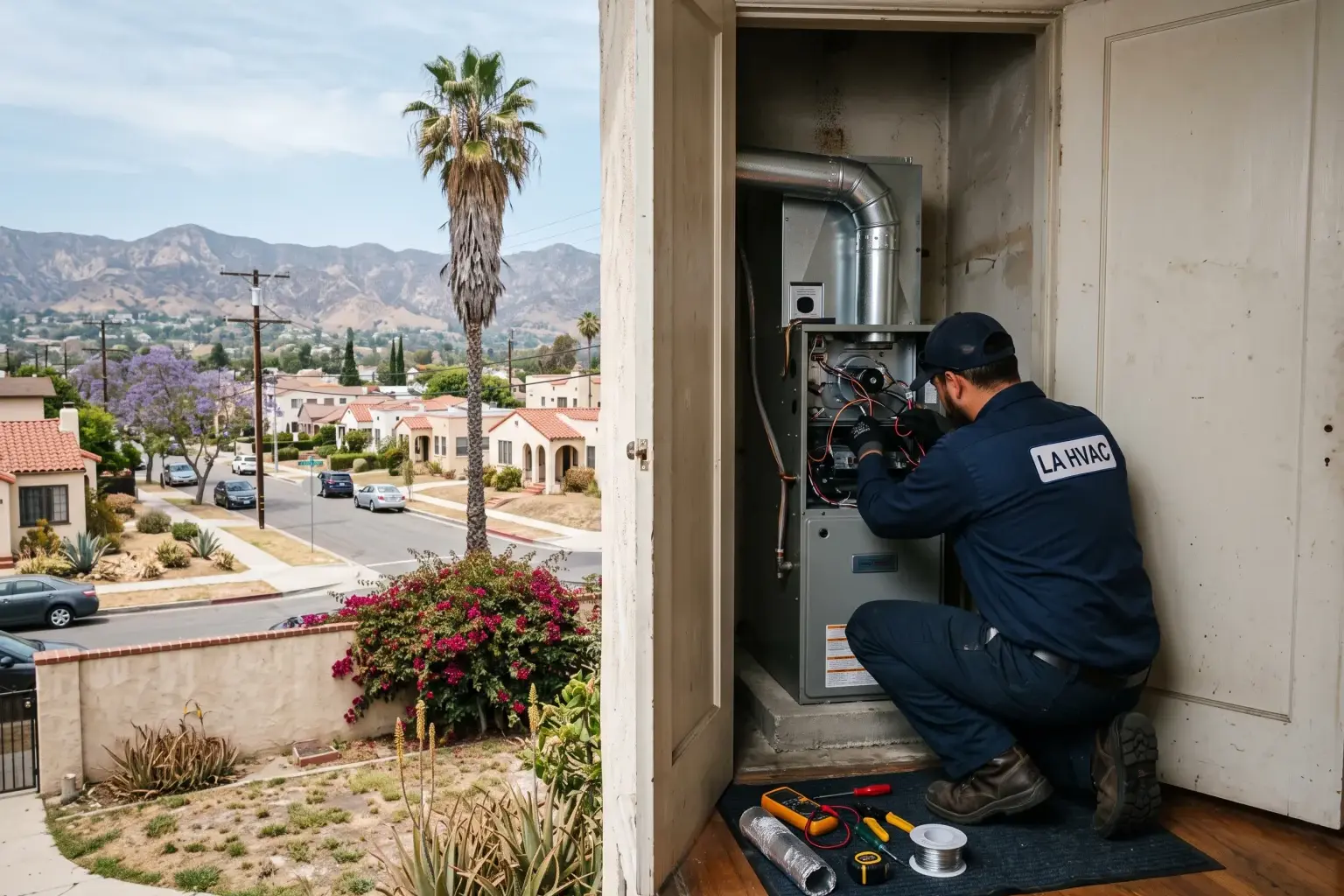
The short answer
You likely need a new furnace if repairs are frequent, the heat exchanger is cracked, or the system can't keep your home comfortable. We inspect the furnace, ducts, and venting, explain your repair and replacement options, including gas furnaces and heat pumps, and check current South Coast AQMD rules and utility rebates before quoting.
Furnaces in Los Angeles don't run much most of the year, but on a cold winter night you want heat that comes on reliably and runs safely. Royal HVAC Solutions installs new furnaces and replaces worn-out heating systems for homeowners across Los Angeles and surrounding cities. This page covers how to tell when it's time for a new furnace, what we inspect before recommending anything, when repair still makes sense, what affects the cost, and what to expect during the visit.
Signs You May Need a New Furnace
Los Angeles winters are mild, so many furnaces sit idle for months and then work hard for a few cold weeks. Problems often show up the first time you turn on the heat in fall or winter. Some issues are simple repairs. The signs below point toward a furnace that may be near the end of its useful life.
If you ever smell gas, leave the house and call your gas utility or emergency services from outside before you call us. A cracked heat exchanger or a venting problem can let carbon monoxide into your living space. Keep a working CO detector near sleeping areas no matter how old your furnace is.
- The furnace needs repairs most heating seasons, and the fixes keep getting bigger
- Rooms heat unevenly, or the system runs a long time without making the house comfortable
- A burning smell that doesn't fade after the first few minutes of the season, or soot around the unit
- A burner flame that looks yellow or flickers instead of burning a steady blue
- Banging, rattling, or squealing when the system starts or runs
- Gas bills that climb while your habits stay the same
- Replacement parts that are hard to find for your model
- An addition, garage conversion, or duct replacement that leaves the current unit the wrong size
What We Check Before Recommending a New Furnace
We don't recommend a replacement based on age alone. A technician inspects the current system and the house it serves, so any new equipment is the right size and installed correctly.
Sizing matters. An oversized furnace turns on and off too often, wears out parts faster, and causes temperature swings. An undersized one runs nonstop. We base our recommendation on your actual house instead of copying the old unit's label.
- Heat exchanger condition, including cracks, rust, or signs of overheating
- Burners, ignition, flame sensor, and gas pressure
- Venting and flue connections, including clearances and draft
- Blower motor, drive components, and electrical connections
- Thermostat operation and wiring
- Ductwork in attics and crawl spaces, looking for leaks, crushed runs, and loose connections
- Return air size and filter location, since too little return air can shorten equipment life
- Your home's heating load, based on square footage, insulation, windows, and layout
Repair or Replace: Your Options
If the furnace is in reasonable shape and the problem is one failed part, such as an igniter, flame sensor, inducer motor, or control board, repair is usually the sensible choice. We'll tell you plainly when that's the case.
Replacement makes more sense when the heat exchanger is cracked, repairs are frequent, or the system can't keep the home comfortable. At that point you generally have three options:
In the Los Angeles region, South Coast AQMD Rule 1111 limits NOx emissions from natural-gas fan-type central furnaces sold and installed here. The district has been amending the rule toward zero-emission requirements, and it sets and revises the compliance dates. If you're planning a gas furnace replacement, check the current rule before you choose equipment. We review it with you as part of the quote.
If you're considering a heat pump, rebates may help. LADWP residential electric customers can apply for Consumer Rebate Program rebates on qualifying heat pump systems. The amount is based on the unit's SEER2 and HSPF2 ratings, and you file the application after the equipment is purchased and installed, within 12 months of purchase. Many homes outside the City of Los Angeles get electricity from Southern California Edison instead, so the rebates available to you depend on your utility. We confirm the current offer before quoting it. The federal Energy Efficient Home Improvement Credit (25C) covered qualifying heat pumps placed in service before December 31, 2025, and it isn't available for new installations after that date.
- A new gas furnace, sized for your home and existing ductwork
- A heat pump, which heats and cools with one system and can replace both a furnace and an aging air conditioner
- A dual-fuel system that pairs a heat pump with a gas furnace for backup heat
What Affects the Cost of a Furnace Installation
Every installation is quoted for the specific home. These factors affect the price most:
Ask for a written, itemized quote so you can compare options side by side and see exactly what each one includes.
- Equipment type: gas furnace, heat pump, or dual-fuel system
- Efficiency level and features such as variable-speed blowers or modulating burners
- The capacity your home's size and layout require
- Where the unit sits, whether attic, closet, garage, or crawl space, and how easy it is to reach
- Duct condition, and whether sections need sealing, repair, or replacement
- Changes to venting, gas lines, or electrical service, especially when switching to a heat pump
- Permits and inspections required by your city
- Removal and disposal of the old equipment
- Available rebates, which depend on your utility and the equipment you choose
How a Furnace Installation Visit Works
First, a technician inspects the existing system, measures the home, and asks how you use the space. Inland and valley homes get much hotter summers than homes near the coast, and fall Santa Ana winds can bring hot, dry spells. If you're weighing a heat pump, we look at your cooling needs as well as heating.
Next, you get a written recommendation with options. We explain what each option includes, how it fits current local rules, and which rebates may apply at your address.
On installation day, the crew protects floors and work areas, shuts off gas and power, removes the old unit, and sets the new equipment. They connect gas, venting, electrical, and ductwork. Then they start the system and test ignition, gas pressure, airflow, temperature rise, and venting. If a permit is required, we coordinate the inspection.
Before we leave, we show you how to use the thermostat, how to change the filter, and what normal operation sounds like. We also haul away the old equipment.