
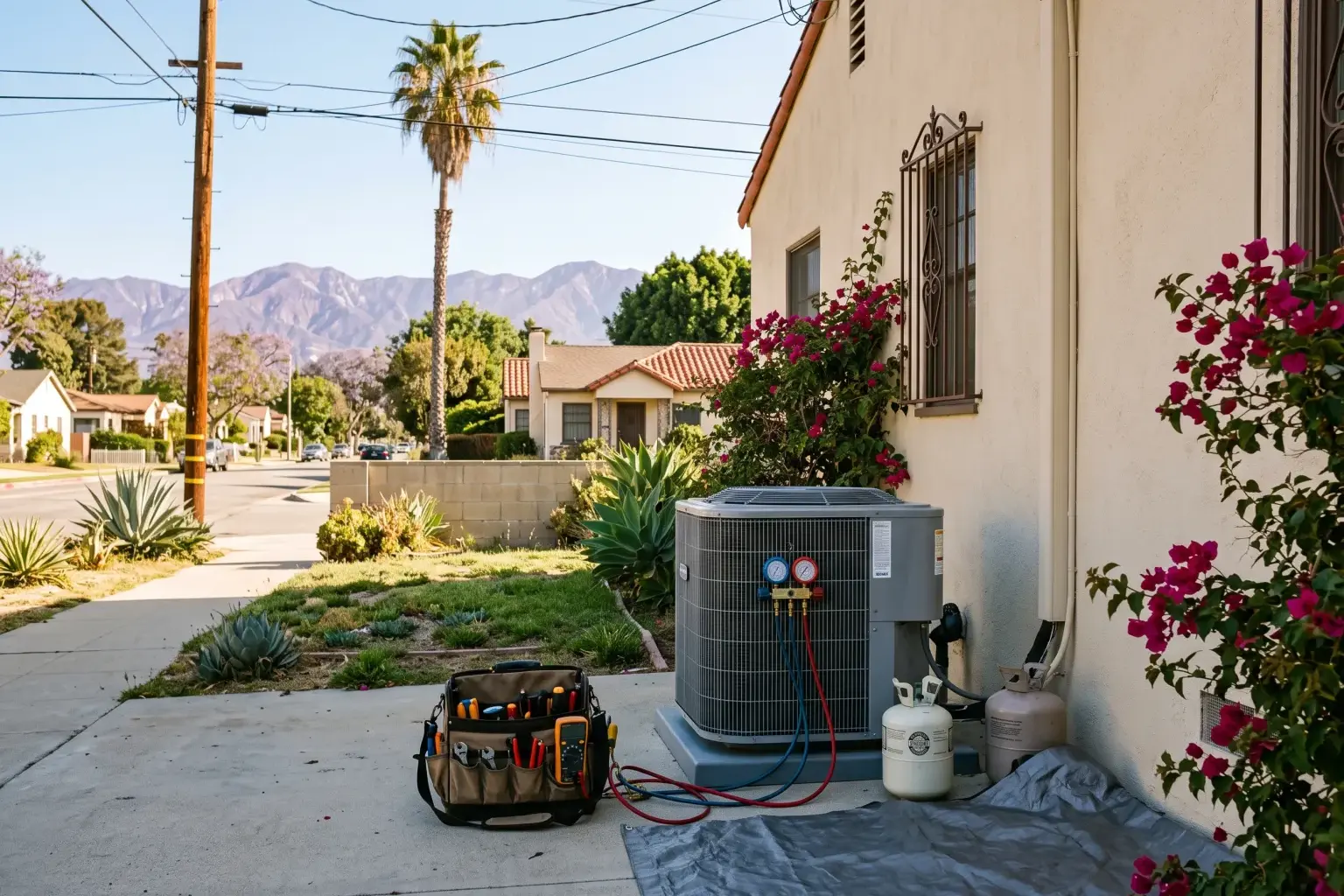
The short answer
Most Los Angeles homes should have HVAC maintenance at least once a year. Ideally, that means a cooling check in spring and a heating check in fall. A maintenance visit cleans, tests and adjusts your system so it runs efficiently, and it catches small problems before they become breakdowns.
Heating and cooling systems in Los Angeles have an uneven workload. Long, dry summers can run air conditioners for weeks at a time, especially in the valleys and inland neighborhoods. Mild winters can leave the furnace or heat pump idle for months until someone switches it on during the first cold night. Regular maintenance catches the small problems that build up between seasons, such as clogged filters, dirty coils, loose wiring, worn parts and drain lines that are starting to back up. Royal HVAC Solutions offers maintenance visits for homeowners in Los Angeles and nearby cities. We service central air conditioners, gas furnaces, heat pumps and ductless systems.
Signs Your System Is Due for Maintenance
You don't need to wait for a breakdown. Many homeowners schedule a cooling check in spring, before the heat arrives, and a heating check in fall, before the Santa Ana winds or the first cool evenings. Book a visit if the system hasn't been looked at in more than a year or if you notice any of the following:
- Some rooms are warmer or cooler than the rest of the house
- Airflow from the vents is weaker than you remember
- The system turns on and off in short, frequent cycles
- Electric bills are creeping up even though you use the system the same way
- There are new noises, such as rattling, grinding, squealing or loud clicks at startup
- Water collects around the indoor unit, or a drain line drips constantly
- You smell something burning or musty when the system starts
- The house is dustier than usual, or the filter clogs quickly
What We Check During a Maintenance Visit
A maintenance visit is a hands-on inspection, not a quick glance at the thermostat. The exact list depends on your equipment, but a typical visit covers the following:
We write down what we find, including anything that looks fine today but is worth watching. If something needs repair, we explain the problem and let you decide before we do any additional work.
- Thermostat settings, calibration and wiring
- Air filter condition and size, with a replacement if you have the right filter on hand or ask us to supply one
- Indoor blower motor, blower wheel and belt (where your system has one), cleaned and checked for wear
- Outdoor condenser coil and fins, cleared of dirt, leaves and debris
- Refrigerant pressures and temperature split, to confirm the system cools as it should
- Capacitors, contactors and electrical connections, tightened and tested
- Condensate drain line and pan, flushed and checked for clogs
- Furnace burners, flame sensor and ignition, plus a check of the heat exchanger for visible cracks or damage
- Gas connections and venting, checked for proper draft
- Heat pump reversing valve and defrost operation
- Ductwork near the equipment, checked for loose joints or gaps
Repair or Replace: What a Maintenance Visit Can Tell You
Most maintenance visits end with a clean, adjusted system and nothing else to do. Sometimes the inspection turns up a worn part or a bigger problem. When that happens, we lay out the choices plainly so you can decide.
Repair usually makes sense when the problem is a single component and the rest of the system is in reasonable shape. Common examples are a capacitor, fan motor, igniter or drain problem. Replacement is worth discussing in these situations:
If you are thinking about a new furnace, keep in mind that the South Coast AQMD regulates emissions from natural-gas furnaces sold and installed in this region. The district has been moving those rules toward zero-emission requirements, and it sets and revises the compliance dates. Check the current rule before you plan a gas furnace replacement. We can walk you through what applies when you're deciding.
Many homeowners use this decision point to look at a heat pump, which handles both heating and cooling. Available rebates depend on which utility serves your address:
The federal tax credit for heat pumps covered only systems placed in service before the end of 2025. It is not available for new installations.
- The system needs a major part, such as a compressor or heat exchanger
- The system has needed several repairs in a short time
- The system struggles to keep the house cool during hot inland summers
- The system uses an older refrigerant that is becoming harder to service
- LADWP customers may be able to apply for a rebate on a qualifying heat pump system. The amount is based on the unit's efficiency ratings. You file the application after the equipment is purchased and installed, within 12 months of purchase.
- Many homes outside the City of Los Angeles are served by Southern California Edison instead of LADWP, so different rebates may apply. We confirm the current offer before quoting it.
What Affects the Cost of HVAC Maintenance
We give you a clear price before work begins. The cost of a maintenance visit depends on a few things:
Repairs found during maintenance are priced separately. We don't start them without your approval.
- The number of systems in the home, such as a separate unit for an upstairs floor or an addition
- The type of equipment: an air conditioner and furnace pair, a heat pump, or a multi-zone ductless system
- Access to the equipment, such as attics, tight closets, crawl spaces and rooftop units
- How dirty the coils and drain lines are, especially if the system hasn't been serviced in a while
- Filters or small parts that need to be replaced during the visit
- Whether you want a single visit or a seasonal schedule that covers both cooling and heating
How a Maintenance Visit Works
When you book, we ask about your equipment, its approximate age and any problems you've noticed. That helps the technician bring the right filters and parts. On the day of the visit, the steps are:
Most visits take an hour or two for a single system. Have someone home who can let us in and give us access to the attic, closet or garage where the equipment is located.
- We arrive in the scheduled window and ask what you've noticed about the system
- The technician inspects, cleans and tests the indoor and outdoor equipment
- We run the system through a full cycle to confirm it heats or cools correctly
- You get a plain-language summary of what we checked, what we adjusted and anything that needs attention
- If repairs are needed, we explain the options and the price before any work starts